



Muse Spark 1.2
The same product, a new grade: ship-like/muse-spark-1.2 matches Muse Spark 1.2's quality and behavior at a fraction of the cost — guaranteed at least half, backed by our quality SLA.
Ship gives you the highest intelligence per dollar of any frontier model by finding the cheapest execution that still meets a model's quality grade. We first introduced it for Claude Opus 4.8 and GPT 5.6 Sol. Today we're adding Muse Spark 1.2 with the same quality SLA, the same cost reduction, and the same ease of use.
Just name a reference model as a quality grade, and we fulfill each request in the cheapest way that still meets that grade. We measure both Capability Equivalence and Behavioral Equivalence to the reference model, so that the model performs as well as expected, and it works the same way within your harness when you switch to ship.
TL;DR. Change model="meta/muse-spark-1.2" to model="ship-like/muse-spark-1.2". Same answers, same behavior, for at least 50% less (in our evals, 45% of base cost — about 55% less) with a quality SLA. New to Ship? Start with Introducing Ship.
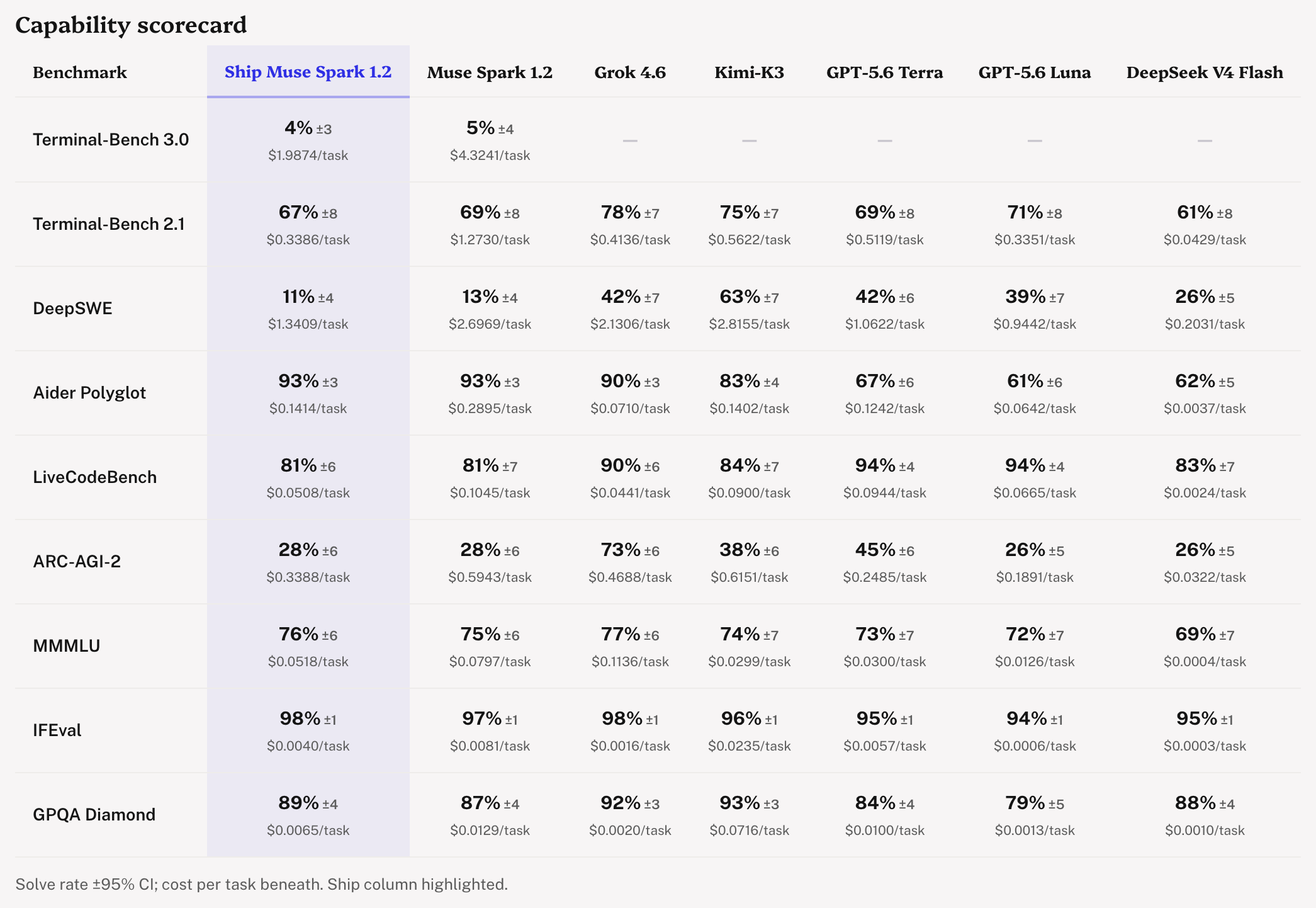
Capability equivalence
Across all nine public benchmarks we tested, Ship lands inside its reference model's margin of error — at a fraction of the cost per task.
Behavioral equivalence
A drop-in replacement has to act like the model it replaces, or you'd have to change your harness (prompts, parsers, tools, etc.). Muse Spark 1.2's Ship grade has a 98% distributional overlap with it across nine behavioral axes.
Zoom into tool use and the two grades reach for the same tools in the same proportions — so a prompt tuned to Muse Spark 1.2's tool habits behaves the same on Ship. The time budget splits the same way, too — most of it in model generation, the rest in tool execution — so latency profiles match, not just totals.
Step back to the whole trace and the equivalence is holistic: embed each run and Ship lands inside Muse Spark 1.2's cloud, while a model with similar benchmark performance sits clearly apart.
And it's task-for-task, not just on average. Bucket every task by how often Muse Spark 1.2 solves it, and Ship tracks it bucket-for-bucket far more tightly than any other model — a per-task correlation of r=0.88, against r=0.57 for the closest comparison model. The same hard tasks stay hard, the same easy ones stay easy.
Get started
This new ship model is available now. Swap one string:
model="ship-like/muse-spark-1.2"
Bring your private evals or production traffic and we'll compare Ship against your current model directly. Get an API key · Talk to us about an SLA.